


Nicomedes Santa Cruz
1925-1992
In October of 2005, I made my first, but certainly not my last, trip to Perú primarily to connect with Afro-Peruvian culture. As a music lover, I was attracted to Perú by a CD entitled The Soul of Black Perú. The CD features leading Afro-Peruvian artists such as the prolific writer, musician, poet, and Black cultural icon Nicomedas Santa Cruz. Thus, the date of June 4, Santa Cruz's birthday, was chosen as Afro-Peruvian Culture Day in his honor, and this celebration will carry on for the rest of the month. Perú has several Black heritage events throughout the year, such as Verano Negro, Santa Efigenia, and Yunga.

Mamainé, Peruvian soul food restaurant
in Perú's District of El Carmen.
According to unofficial estimates, Perú's Black population makes up 10%-15% if you count the one-drop of Black blood rule that is applied here in the US. The majority of Afro-Peruvians live in the nation's capital of Lima and in the port city of Callao but there are also large communities in the Northern and Southern regions as well, especially in the area known as Yungas where the plains meet the Andes.

St. Martin de Porres, noted for his tireless work on behalf of the poor. A district in Lima is named in his honor.
The first Africans arrived in Perú with the conquistadors in 1521 serving as soldiers, personal servants, and body guards. Later, when African slaves arrived in the urban areas of Perú, they served as cooks, laundry persons, maids, handymen, and gardeners. Cañete, Perú, just South of Lima, and Chincha, Perú, about three hours South of Lima, are where a large portion of African slaves were brought to work the cotton fields and other plantations. Both Cañete and Chincha are recognized as the hub of Afro-Peruvian music and dance. However, due to a heavy influx of indigenous people migrating from the Andean areas, and so many Blacks leaving for the bigger cities in search of jobs, the Blacks in Cañete and Chincha are no longer the majority. When I pass through Cañete, I don't see any Blacks at all as they are concentrated in Cañete's District of San Luis. In Chincha, I don't see a large concentration of Blacks until I get to the District of El Carmen, where I stay with Perú's famous Ballumbrosio family.
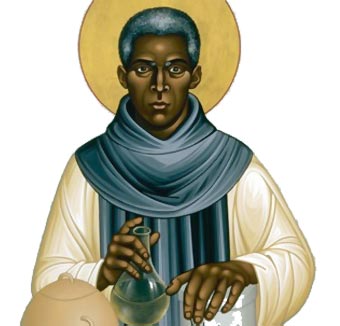
St. Martin de Porres, noted for his tireless work on behalf of the poor. A district in Lima is named in his honor.
The first Africans arrived in Perú with the conquistadors in 1521 serving as soldiers, personal servants, and body guards. Later, when African slaves arrived in the urban areas of Perú, they served as cooks, laundry persons, maids, handymen, and gardeners. Cañete, Perú, just South of Lima, and Chincha, Perú, about three hours South of Lima, are where a large portion of African slaves were brought to work the cotton fields and other plantations. Both Cañete and Chincha are recognized as the hub of Afro-Peruvian music and dance. However, due to a heavy influx of indigenous people migrating from the Andean areas, and so many Blacks leaving for the bigger cities in search of jobs, the Blacks in Cañete and Chincha are no longer the majority. When I pass through Cañete, I don't see any Blacks at all as they are concentrated in Cañete's District of San Luis. In Chincha, I don't see a large concentration of Blacks until I get to the District of El Carmen, where I stay with Perú's famous Ballumbrosio family.

As in every nation that was involved in the slave trade, an important part of Perú's history and heritage have been built with the efforts of Black people who have influenced and contributed heavily to Peruvian culture and identity, especially in music, food, athletics, dance, arts, science, and religion.

Teófilo Cubillas
Perú's all-time leading scorer in soccer

Mauro Mina
The “Chincha Bomber” - Former South American Light-Heavyweight Champion, ranked #1 in the world by Ring Magazine.

Lucila Campos, one of the original members of the world's famous dance troupe, Perú Negro (Black Peru) also became a solo artist of Afro-Peruvian music.

Ronaldo Campos de la Colina
Founder of world's famous Perú Negro (Black Peru) dance troupe


0 comments:
Post a Comment