1970 Topps Baseball

  • Subscribe to our RSS feed.
  • Twitter
  • StumbleUpon
  • Reddit
  • Facebook
  • Digg

Sunday, 11 August 2013

Black Communities of Central America

Posted on 17:15 by blogger
Garífuna in Peril


The Garifuna people (pronounced Gah-REE-fuh-ah), descendants of West Africans who intermarried with Indigenous people, namely the Caribs and Arawaks, primarily in Central America, along the Caribbean Coastal areas of Belize, Guatemala, Nicaragua, and Honduras. According ton one genetic study, the ancestry of the Garífuna peopl on average is 76% Sub-Saharan African, 20% Arawak or Carib, and 4% European. A

Due to heavy migration, the United States has become the second largest hub of Garífuna people outside Central America. New York has the largest population, heavily dominated by Hondurans, Guatemalans and Belizeans. Los Angeles ranks second with Honduran Garifuna being the most populous, followed by Belizeans and Guatemalans. There is no information regarding Garifuna from Nicaragua having migrated to either the East or the West Coast of the United States. The Nicaraguan Garifuna population of today is quite small and community leaders are attempting to resurrect the Garifuna language and cultural traditions. 

Garífuna is music is quite different from the rest of Central America. The most famous form is punta, a musical style, which has the dancers move their hips in a circular motion. An evolved form of traditional music, still usually played using traditional instruments, punta has seen some modernization and electrification in the 1970s; this is called punta rock. Drums play a very important role in Garifuna music.

Their language is primarily derived from Arawak and Carib, with English, French, and Spanish to a lesser degree. Almost all Garifunas are bilingual or polylingual, speaking the official languages of the countries they inhabit such as Spanish and English, most commonly as a first language. In 2001 UNESCO proclaimed the language, dance, and music of the Garifuna as a Masterpiece of the Oral and Intangible Heritage of Humanity in Nicaragua, Honduras, and Belize.

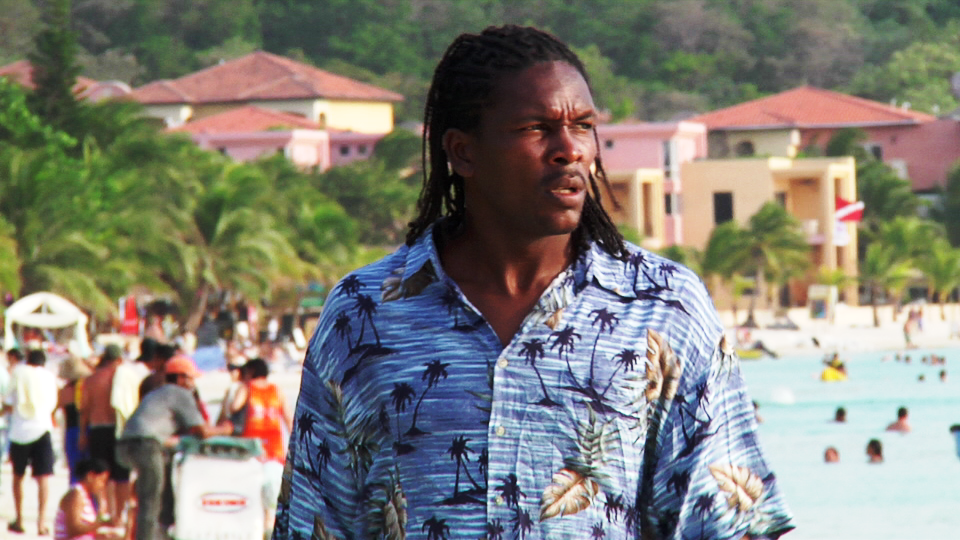
A Garifuna language teacher, Ricardo, struggles to preserve his endangered African-Amerindian culture by building a language school back in his home village in Honduras, Central America. A business venture with his brother designed to raise money for the school’s construction becomes complicated by the expansion plans of a nearby tourist resort into indigenous territory. Historical parallels are invoked as Ricardo’s son rehearses a stage play about the Garifuna people’s last stand against British colonialism over 200 years ago in their motherland, the island of St. Vincent in the Caribbean. Naturalistically shot, with debut performances by nearly the entire cast, “Garifuna in Peril” makes its own history as the first feature film with the majority of dialogue in Garifuna, a language proclaimed by UNESCO as a Masterpiece of the Oral and Intangible Heritage of Humanity. the Garifuna (pronounced Gah-REE- fu-nah) aredescendants of Carib, Arawak, and West African people.

There will be screening the movie Garifuna in Peril in San Francisco at the AMC Theatre on Van Ness Avenue. This event is for one time only on Thursday, August 22, 2013 at 7:30 p.m. Tickets are on sale at https://www.tugg.com/go/3znt9t .This event will not happen unless we reach a threshold of ticket sale
Email ThisBlogThis!Share to XShare to FacebookShare to Pinterest
Posted in Afro-Guatemalans, Belize, Black Guatemalans, Central America, Garífuna, Honduras, Nicaragua | No comments
Newer Post Older Post Home

0 comments:

Post a Comment

Subscribe to: Post Comments (Atom)

Popular Posts

  • Ecuador Celebrates Black Heritage Week
      Afro-Ecuadorian Cultural Center (below) Negro, negro renegrido       Black, black, blackened Negro, hermano del carbón       black, broth...
  • My New Revelations on Black Perú
    Until today, the focus of my Afro-Peruvian experience and observations has been on the province of Chincha in Southern Perú, dubbed as the ...
  • Black Communities of Central America
    Garífuna in Peril The Garifuna people (pronounced Gah-REE-fuh-ah), descendants of West Africans who intermarried with Indigenous people, na...
  • Afro-Ecuadorian Outsmarts Her Slave Masters
    María Chinquiquirá (pronounced Cheen-kee-kee-RAH), a former black slave in what is now Ecuador's largest city, Guayaquil, is today an im...
  • September - Bolivian “Black Heritage” Month
    Black Bolivian music and dance known as “Saya” In 2011, the National Afro-Bolivian Council declared September to be Black Heritage Month wi...
  • Contemporary Expert on “Black” Mexico
        Professor Bobby Vaughn, PhD AFRO-MEXICO With my being a lifetime student of the Spanish language and an explorer of Black heritage in La...
  • Why Am I Not Considered “Black” All of a Sudden?
      I'm in the back (2nd from right) with members of a Black  family in El Carmen, Perú, the hub of Afro-Peruvian culture My Spanish is fa...
  • Argentina's Black Awareness and Civil Rights Movements
      María Elena Lamadrid When Maria Lamadrid went to the immigration counter with her new Argentine passport in preparation for her trip to Pa...
  • My Issue With the World-Renoun Afro-Peruvian Singer Susana Baca
    It was in 2010 when I posed a question about the world-class Afro-Peruvian singer Susana Baca in my blog post entitled, A Question about Sus...
  • Who Is Black? A Latina Asserts Her Identity!
    I was just an 18-year-old Freshman at the State University of New York at Albany where one Saturday morning, a group black students gathe...

Categories

  • African American-Latino World
  • African Diaspora
  • African-American men
  • afro bolivian
  • Afro Costa Rica
  • Afro Dominicans
  • Afro Latinos
  • Afro-Argentina
  • Afro-Bolivians
  • Afro-Colombians
  • Afro-Cuban
  • Afro-Cubans
  • Afro-Ecuadorians
  • Afro-Guatemalans
  • Afro-Latinas
  • Afro-Latinos
  • Afro-Mexicans
  • Afro-Nicaragua
  • Afro-Nicaraguans
  • afro-paraguay
  • Afro-Peruvian
  • Afro-Peruvians
  • Afro-Puerto Rican
  • Afro-Venezuelans
  • America
  • Belize
  • black Argentina
  • Black Bolivians
  • black Colombians
  • black Costa Rica
  • black Cuban
  • black Cubans
  • Black Dominican Republic
  • black Ecuadorians
  • Black Guatemalans
  • black heritage month
  • Black Latinas
  • black Latinos
  • Black Men
  • black Mexicans
  • black Nicaragua
  • black Nicaraguans
  • black Peruvian
  • black Peruvians
  • black Puerto Rican
  • black Venezuelans
  • Black Women
  • black-latinos
  • Caracas
  • Central America
  • Colombia
  • Costa Rica
  • crime
  • Cuba
  • Culture
  • Dating
  • Dominican
  • Dominican Republic
  • Ecuador
  • Expat
  • Expatriot
  • Flamenco
  • Garífuna
  • Giving
  • Honduras
  • Illegal Aliens
  • interracial children
  • Interracial Marriages
  • Latin America
  • Latin American culture
  • Latin American Etiquette
  • latin american racism
  • Latin music
  • Latin-American travel
  • Latinas
  • Latino
  • Latinos
  • Learning Spanish
  • Love
  • Men
  • Mexican-American
  • Mexico
  • Mothers Day
  • Nicaragua
  • Nuyorican
  • paraguay
  • peru
  • Perú
  • peru peruvian
  • Prejudice
  • Puerto Rican
  • Puerto Rico
  • racism
  • Relationships
  • Retirement
  • salsa
  • Salsa music
  • Spain
  • Spanish
  • Stereotypes
  • The Spanish language
  • Travel
  • Venezuela
  • Women

Blog Archive

  • ▼  2013 (99)
    • ►  December (5)
    • ►  November (9)
    • ►  October (8)
    • ►  September (9)
    • ▼  August (9)
      • September - Bolivian “Black Heritage” Month
      • Challenges of Blacks in Central America and the Un...
      • My Long Distance Spanish Teacher
      • African-American in a Spanish-Speaking Texas Town
      • Visiting Rough Parts of Lima, Perú—I’VE BEEN WARNE...
      • The Salsa Turntable is for “Latinos Only!”
      • Black Communities of Central America
      • Once the Forgetful, Self-Centered, American Traveler
      • My Interactions with Latin American Women
    • ►  July (10)
    • ►  June (9)
    • ►  May (8)
    • ►  April (8)
    • ►  March (8)
    • ►  February (8)
    • ►  January (8)
  • ►  2012 (1)
    • ►  December (1)
Powered by Blogger.

About Me

blogger
View my complete profile